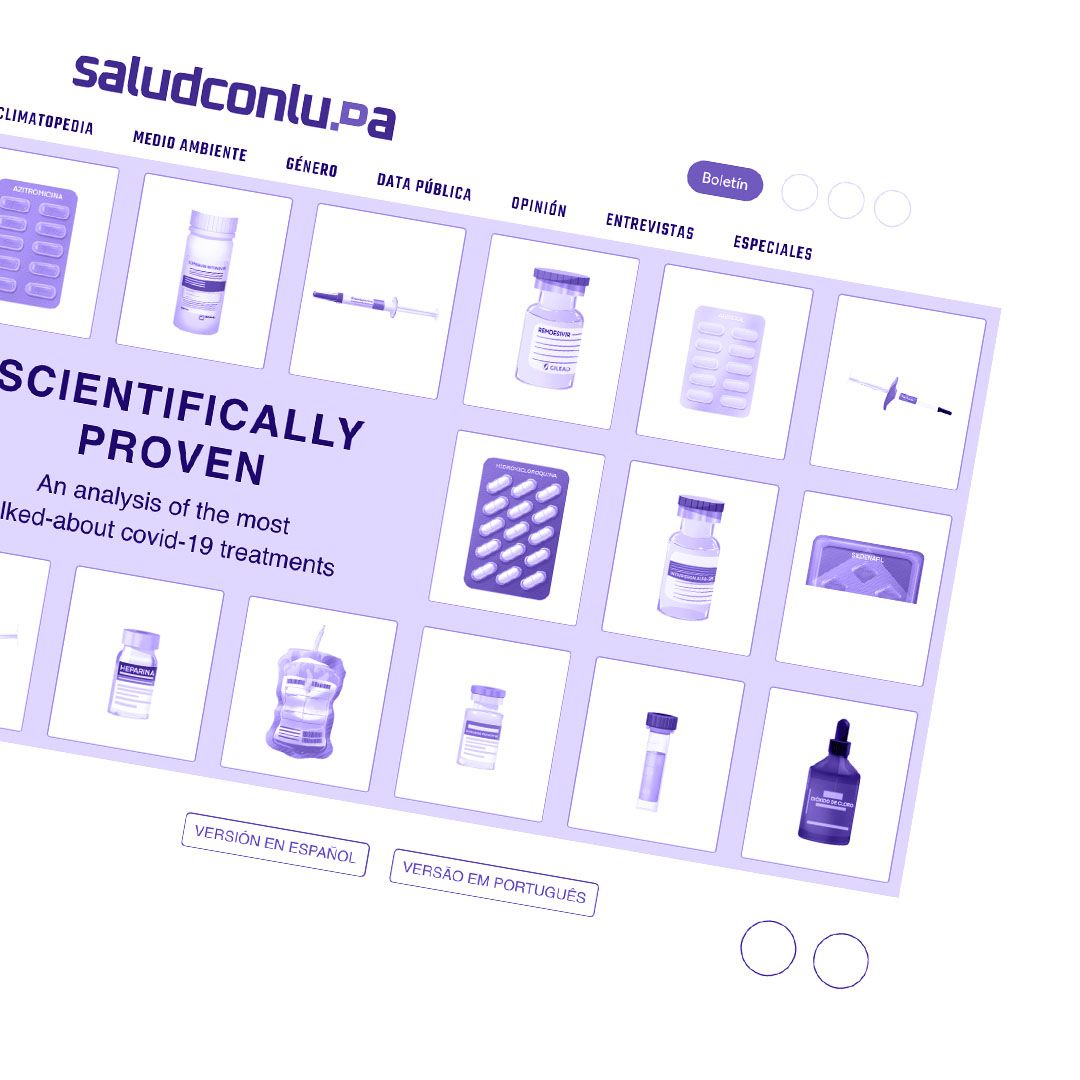
This one-of-a-kind project that was co-developed with 'Salud con lupa' was nominated for the 2021 Gabo Award for Ibero-American Journalism and the Sigma Awards 2022.
21|AUGUST|2023
Scientifically Proven: Two years of the reporting project
This one-of-a-kind project that was co-developed with 'Salud con lupa' was nominated for the 2021 Gabo Award for Ibero-American Journalism and the Sigma Awards 2022.
Epistemonikos and Salud con lupa take stock of the experience of the cooperation behind Scientifically Proven, the project that tracked the evolution of medications and therapies against COVID-19 for over two years.
In May 2020, then-President of the United States, Donald Trump, revealed that he was using hydroxychloroquine to prevent COVID-19 infection. His statements added to the media impact of a study published in March of the same year, involving only 36 patients, which claimed that those who received hydroxychloroquine cleared the virus faster than those treated with conventional care.
Hydroxychloroquine, an antimalarial drug, became a popular treatment for preventing and supposedly "curing" COVID-19, despite lacking scientific evidence. The main evidence supporting the use of hydroxychloroquine for COVID-19 was the aforementioned non-randomized trial conducted by French researchers, involving 36 hospitalized patients in a single healthcare center in France.
In addition to hydroxychloroquine, other treatments for COVID-19 were also part of everyday conversations among people worldwide, and most of them were still under investigation. This created a favorable scenario for the rampant spread of misinformation, which became a pandemic in itself. This health misinformation pandemic was exacerbated by the continuous publication of numerous scientific studies on potential treatments, which, due to their quantity and nature, were overwhelming and difficult to manage for both the general public and health experts.
With the aim of contributing to public debate and providing reliable information to the public, a special report titled Scientifically Proven: an analysis of the most used treatments against COVID-19 was launched in September 2020, in a collaboration between the Epistemonikos Foundation and Salud con lupa. The idea was to create a summary report of the existing evidence and an analysis of the evolving evidence available for the most widely used interventions (medications and other therapies) against COVID-19.
Together, the teams from the Epistemonikos Foundation and Salud con lupa selected the interventions to be included in Scientifically Proven considering those most discussed and widely used, based on information from users, key stakeholders, press media, social networks, and other sources (see methodology). Fabiola Torres, director of Salud con lupa, pointed out "In a time of high uncertainty and a huge volume of information to review, the alliance between Salud con lupa and the Epistemonikos Foundation was crucial because only by combining our efforts could we manage and analyze the scientific studies and data in the best way."
The evidence provided by hundreds of clinical trials was reviewed, filtered, and summarized by the Epistemonikos team using the open-access tool "COVID-19 Living Overview of Evidence (L.OVE)" which serves as both a repository and a map of evidence, continuously updated through automatic searches in 41 electronic databases, preprint servers, clinical trial registries, and other relevant sources.
Gabriel Rada, the director of Epistemonikos, explained the scale developed to classify interventions according to their suitability for use in patients and the state of scientific research advancement. He said "Since the evidence from clinical trials alone is not enough to decide whether a medication is effective or not, as other variables such as adverse effects, costs, among others, need to be considered, we developed a seven-level scale precisely for that purpose. We devised a method to rigorously, explicitly, and transparently process all those variables and ultimately proposed a way to rank according to the information available for each variable and show whether a treatment is ready or not for use". He also emphasized that "over the two years of the project, we could verify that this method allowed us to predict, with a high level of accuracy and much faster, which treatments eventually proved useful and which did not".
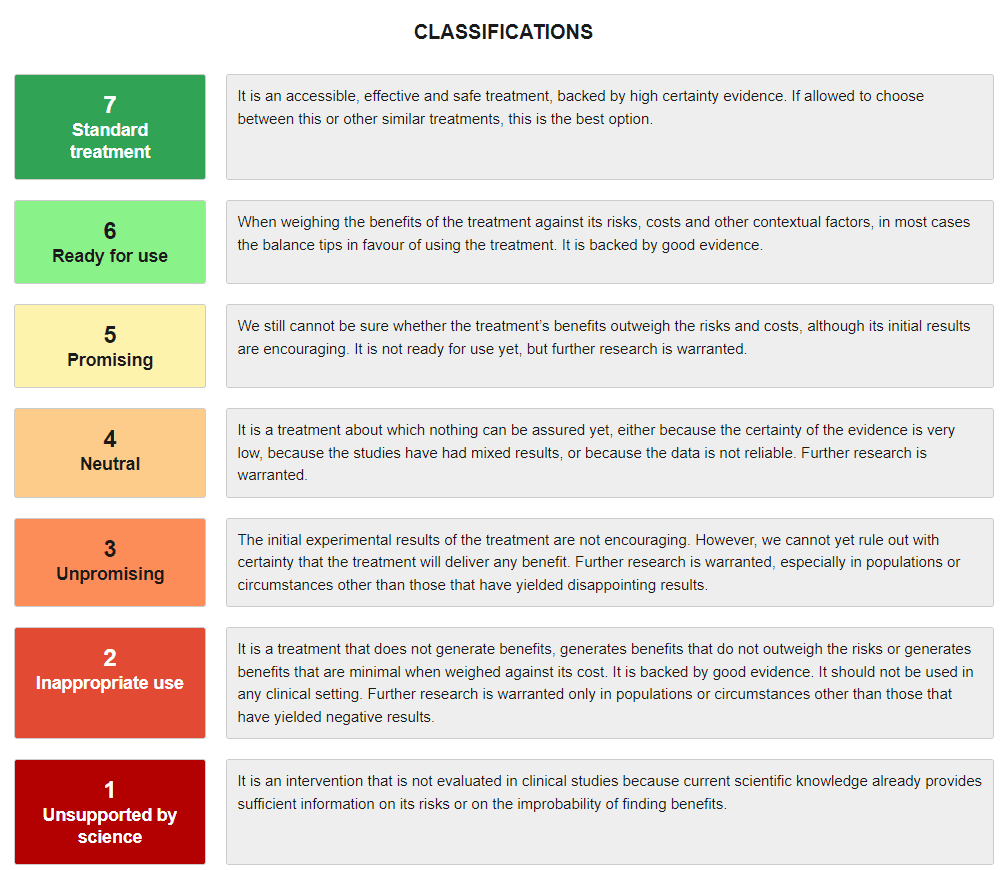
Scientifically Proven was periodically updated for almost two years, during which some treatments were approved by relevant regulatory agencies, while others were discarded due to their inefficacy or associated risks. Additionally, the special report was nominated for the Sigma Awards 2022, one of the most prestigious awards in the field of data journalism, and for the 2021 Gabo Award for Ibero-American Journalism in the innovation category.
"These recognitions valued the importance of collaboration between journalists and scientists. Rarely do they come together to develop informative tools useful to the public. Our organizations achieved it in a complex moment when cooperation was most needed to navigate information related to COVID-19 therapies", explained Fabiola Torres.
The last update of Scientifically Proven was in August 2022 and featured monoclonal antibodies against SARS-CoV-2, including sotrovimab and bebtelovimab, the inhalable anti-inflammatory budesonide, and the antiviral aviptadil.
Regarding this, Dr. Rada pointed out that as the general interest in the pandemic started to decline, they noticed fewer visits and interactions on social media. That's why they first decided to decrease the frequency of updates and eventually made the decision to stop updating it. Additionally, this allowed them to focus their energies on replicating this project in other areas. "The pandemic offered us a unique opportunity to focus entirely on one disease. Now, we have to see if with the resources we have, we are capable of replicating the same in the hundreds or thousands of diseases that exist", emphasized Rada.
For Salud con lupa, the cooperation with Epistemonikos was a valuable learning process of how protocols for evaluating scientific evidence work and, above all, the importance of knowing how to classify information. "It was a very gratifying experience due to the willingness of the foundation's scientists", highlighted Torres.
The co-founder of Epistemonikos shared his evaluation with the following words: "The experience was extraordinary from several perspectives. On one hand, it's the project that allowed us to connect more directly with the general public. The numbers and feedback were very positive. The nomination for journalism awards is also a testament to that".
The information gathered, whether through live reporting or more detailed versions, helped meet the needs of decision-makers at the national and international levels. This was done directly or by integrating the data into international projects, such as those that contributed to the World Health Organization's guidelines or several joint projects with the Pan American Health Organization. Gabriel Rada concluded that "Ultimately, this experience confirmed to us that the synergy between the scientific and journalistic worlds can bear very good fruits. It is a lesson that we will keep in mind for all future initiatives".